Navigating the Cladding Crisis: Why End-to-End Remediation is the Key for London’s High-Rises
For thousands of Londoners, the “cladding crisis” is not just a headline—it is a daily reality. Recent reports highlight the immense pressure on the capital, which houses 61% of England’s high-rise buildings. With the Building Safety Regulator (BSR) under fire for approval delays and a mounting backlog, the path to safety can feel “difficult, slow, and uncertain” [1].
However, new reforms aimed at streamlining approvals and a government mandate for all buildings over 11m to be remediated by 2029 are finally moving the needle. In this high-stakes environment, the choice of contractor isn’t just a construction decision; it’s a compliance and safety lifeline.
Here is why an end-to-end partner like TP Construction is essential for navigating these new regulations and securing your building’s future [2].



The London Challenge: Speed vs. Safety
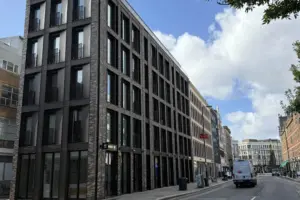
As the Mayor of London recently noted, the capital has “more than double the amount of dangerous buildings than the rest of the country put together” [1]. The primary bottleneck has often been the back-and-forth between developers and the BSR over paperwork and technical specifics.
The BSR’s new “targeted package of measures” aims to reduce decision times to less than 12 weeks. To hit these windows, applications must be perfect from day one. This is where the value of an end-to-end contractor becomes clear.
The Power of the “End-to-End” Model
When a project is fragmented between different consultants—inspectors, architects, and installers—details often fall through the cracks, leading to the very “back-and-forth” delays the BSR is trying to eliminate.
TP Construction’s model integrates every phase:
-
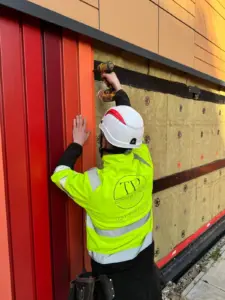
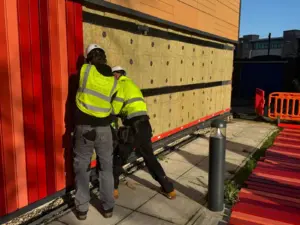
Forensic Investigation & Design: We do not just look at the surface. We perform intrusive “opening up” works to inspect cavities and fire barriers. By working with top-tier partners like ARUP, we ensure the replacement design is fully accredited before a single panel is removed [2].
-
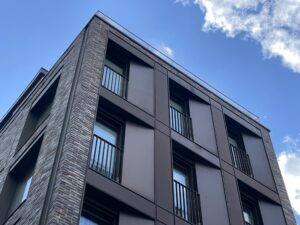
Specialist Knowledge of Materials: Whether it is replacing hazardous insulation behind brick slips, installing A1-rated aluminium systems, or providing flawless rendered finishes, we specialise in the materials that meet the latest fire-safety standards [3].
-
London-Specific Logistics: Managing a remediation project in a busy urban environment is a unique challenge. From site security and scaffolding to resident liaison, we handle the complexities of working in one of the world’s busiest cities.
Managing the “Human” Element: Resident Liaison
The Standard article highlights the emotional toll on residents trapped in “unsellable and unsafe” properties [1]. Remediation is a long process that often happens while the building is fully occupied.
At TP Construction, we prioritise occupant consideration. We assign dedicated site managers and follow strict protocols to ensure residents are kept safe and informed. As showcased in our work on the St. Giles Hotel at Heathrow, we have extensive experience delivering high-profile facade replacements in fully occupied, high-traffic environments without compromising safety or quality [2].
Compliance and Peace of Mind
With the 2029 deadline looming and the threat of severe penalties for non-compliance, property owners and managers need a “Principal Contractor” who takes full responsibility.
We do not just “fix the wall”; we take your building from “hazardous” status to full certification. Our comprehensive safety documentation and final sign-off are designed to satisfy the BSR, insurers, and lenders—eventually allowing for the issuance of EWS1 forms that let residents sell or remortgage their homes [4].
Conclusion
The reforms to the Building Safety Regulator offer a glimmer of hope for a faster resolution to the cladding crisis. However, the responsibility still lies with building owners to choose a partner capable of meeting these rigorous new standards.
By choosing an end-to-end specialist like TP Construction, you are not just hiring a builder; you are hiring a team of planners, architects, and fire safety advisors dedicated to making London’s skyline safe again.
Footnotes
[1] The Evening Standard, “Building Safety Regulator forced to speed up London cladding repairs after just 18 applications approved in a year,” February 2024. https://www.standard.co.uk/news/london/london-cladding-building-repairs-b1278625.html
[2] TP Construction, “Cladding Remediation Contractors & Facade Replacement,” https://tp.construction/cladding-remediation-contractors
[3] British Standard BS EN 13501-1, “Fire classification of construction products and building elements.”
[4] Royal Institution of Chartered Surveyors (RICS), “The EWS1 process and its role in the cladding crisis.”