The UK’s building safety landscape has shifted from a rigid, “pass-fail” approach regarding materials to a nuanced evaluation of comprehensive risk. At the heart of this transition is PAS 9980, the British Standards Institution (BSI) code of practice. It establishes a standardised framework for a Fire Risk Appraisal of External Walls (FRAEW).
Unlike the early, reactive measures following the Grenfell tragedy in 2017, PAS 9980 moves away from the automatic “strip and replace” mentality. Instead, it looks at a building holistically. Achieving a successful, legally robust outcome under PAS 9980 requires deep integration across three core disciplines: specialised remediation contractors, fire engineers, and architectural designers.
Here is an objective look at how TP Construction, alongside its network of associated fire engineers and architects, systematically navigates this complex process.
A successful PAS 9980 appraisal follows a strict five-step methodology. No single professional can complete this alone; it requires technical oversight at every stage.
An appraisal cannot rely on original “as-built” drawings alone. The initial phase demands rigorous forensic investigation. Specialised cladding contractors support this step by executing precise, localised openings in the façade. This allows professional engineers to examine hidden cavities, verify insulation types, and inspect the presence and positioning of cavity barriers.
Once the exact physical build-up is established, the engineering team evaluates specific risk factors. This includes assessing the combustibility of materials (such as rainscreen cladding, ETICS, or insulated core panels), the configuration of the façade, the building’s height, and its specific occupancy profile.
PAS 9980 stands out because it allows for compensatory features. Before recommending expensive physical alterations, the team evaluates existing internal protections, such as advanced fire alarm systems, automatic sprinkler installations, and optimised means of escape.
The fire engineer synthesises data from the physical survey and the building’s overall fire strategy to assign a definitive life-safety risk rating: Low, Medium, or High.
The final output is a structured FRAEW report. This document outlines whether the risk is tolerable or if physical remediation is required.
To transition from a complex risk assessment to a practical, safe building, three distinct groups must collaborate closely.
The Fire Engineer: Establishing the Evidence Base
The fire engineer is the technical authority of the PAS 9980 process. They look at the building through the lens of pure life safety: If a fire breaks out, how will the smoke and flames behave externally, and will the residents have a tenable escape window?
The engineer dictates whether a Medium Risk classification is truly tolerable with minor modifications, or if a High Risk rating demands a full-scale intervention. They provide the precise data that protects building owners from unnecessary expenditure while ensuring absolute regulatory compliance. Read more about our engineer –Andrew James.
When an appraisal dictates that remediation is unavoidable, the architectural team steps in. Their role is highly technical. They must design a replacement system—such as non-combustible aluminium, rendered, or brick slip systems—that achieves an A1 or A2 fire rating under BS EN 13501-1.
Architects ensure the new façade respects the building’s structural load constraints, thermal efficiency requirements, and weathering capabilities. Crucially, they detail the complex internal interfaces—specifying exactly where fire-stopping and intumescent cavity barriers must sit around windows, floor slabs, and compartment lines to prevent future fire spread. At TP Construction we partner with Roger at Pollard Thomas Edwards architects.
As a principal contractor specialising in cladding remediation within complex urban environments like London, TP Construction bridges the gap between design and physical reality.
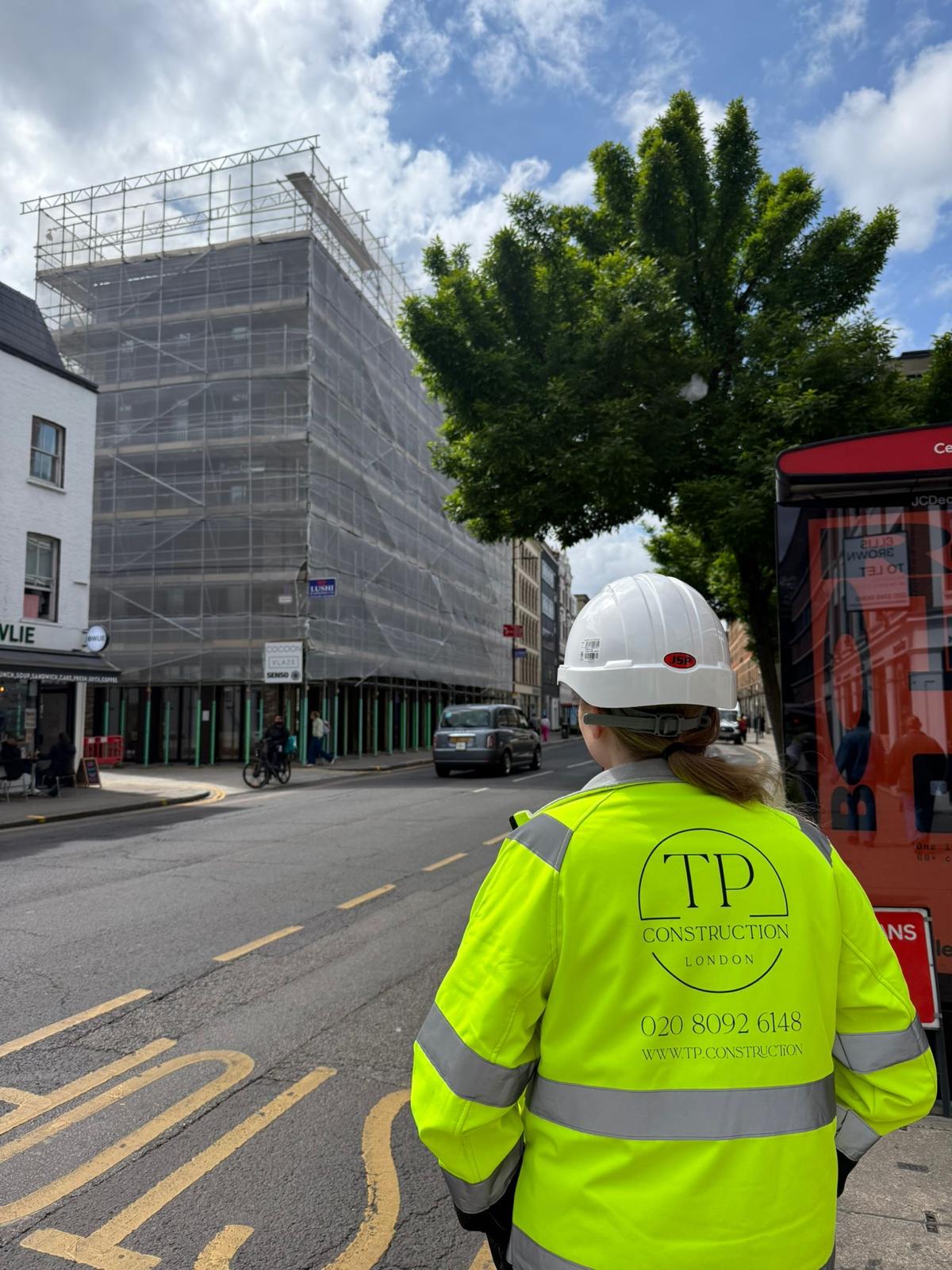
Logistics & Site Safety: Working on occupied multi-storey residential blocks requires rigorous site management. Contractors develop detailed construction-phase fire plans, manage complex scaffolding frameworks, and ensure secure site perimeters to protect both residents and the public.
Safe Hazard Removal: Handling and disposing of non-compliant, highly flammable materials (such as certain Articulated Composite Panels or hazardous cavity insulation) requires specialized hazardous waste protocols.
Precision Installation: A perfect architectural drawing is only as good as its field installation. TP Construction’s site managers ensure that cavity barriers are fitted tightly without gaps, and that technical systems (like SPS Envirowall) are fitted precisely to specification, preventing installation errors that could compromise fire safety.
Proportionality: The Ultimate Goal of PAS 9980
The building sector has learned that blanket solutions are rarely effective. By utilising the integrated approach of specialised contractors, architects, and fire engineers, building owners and managing agents receive a balanced, risk-proportionate solution.
If a building can be made completely safe via targeted interventions—such as improving internal compartmentation or replacing specific high-risk spandrel panels and balconies rather than stripping the entire property—the PAS 9980 methodology provides the framework to justify that decision. When full re-cladding is necessary, this multi-disciplinary alliance ensures the project moves smoothly from initial forensic opening to final accredited hand-over, ensuring complete peace of mind in the post-Building Safety Act era.
As a block manager, building owner or responsible person knowing when to act and make the first step is often very unclear.
Our advice is contact us at TP sooner rather than later, we have a strong network of project managers, engineers and designers that can assist you. Our directors have decades of experience working directly with clients and managers, and due to the lengthy nature of remediation projects we are on hand to start the ball rolling